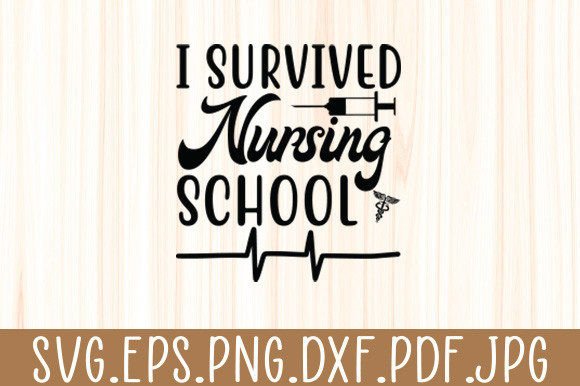
I Survived Nursing School SVG: A Designer’s Review
First Impressions: Celebrating the Milestone with Intent
When evaluating a machine embroidery design intended for nursing graduates, my primary concern is always readability and emotional resonance. The "I Survived Nursing School" concept is a staple in the medical crafting community, but execution matters more than the sentiment alone. As a designer reviewing this specific graphic for potential adaptation into stitch, I look at the balance between the bold declaration of survival and the softer, appreciative nod to "Today's Hero Nurse." Visually, this design carries a dual personality: it is celebratory yet professional. For an Etsy seller or small shop product creator, this duality is gold. It allows the finished item to serve as both a personal victory lap for the graduate and a wearable badge of honor for their new career.
The layout suggests a versatility that appeals to various niches within the Crafts category. Unlike overly complex illustrations that can get lost in translation from screen to fabric, this graphic relies on strong typography and clear iconography. From a digitizing perspective, this is promising. Clean lines in the source Graphics file usually translate to cleaner stitch paths, reducing the risk of thread breaks or registration issues when converting to an embroidery file. However, because this is marketed primarily as a digital file for cutting machines like Cric, any embroiderer must approach this with a critical eye toward digitization suitability before loading it into their software.
Real-World Application: The Graduation Tote Bag Test
To truly judge the viability of this design, I mentally placed it onto a canvas tote bag intended for a nursing graduation gift. Totes are high-stakes projects because the fabric is often unstructured and the surface area is large enough to expose poor spacing. In this scenario, the "I Survived Nursing School" text needs to be anchored properly. If I were stitching this, I would envision the main text in a sturdy satin stitch or a dense fill stitch to ensure it stands out against the natural canvas texture. The "Today's Hero Nurse" subtitle would likely work best as a running stitch or lighter fill to create visual hierarchy without adding excessive bulk.
For a custom apparel project, such as a sweatshirt for a new grad starting night shifts, the design’s mood shifts from celebratory to comforting. Here, the placement is critical. Center-chest placement on a crewneck requires precise hooping to avoid distortion. I considered how this design would interact with the ribbing of a cuff or the seam of a pocket. The beauty of this specific phrase is its adaptability; it works as a left-chest logo size just as well as a full-back statement. For commercial embroidery businesses fulfilling bulk orders for nursing cohorts, this design offers a safe, universally appreciated aesthetic that avoids inside jokes which might alienate some recipients.
Navigating Fabric Challenges and Technical Limits
While the sentiment is universal, the technical application of the "I Survived Nursing School" SVG requires caution depending on your substrate. Not all fabrics forgive ambitious designs. When working with stretchy knits for sweatshirt embroidery or t-shirts, the stitch density becomes the enemy if not managed correctly. A design optimized for vinyl cutting may have details that are too fine for needle and thread. If the original graphic includes thin serifs or intricate flourishes, these must be thickened during digitizing to prevent puckering or thread shredding on jersey fabrics.
Textured fabrics present another hurdle. If you are creating a tote bag design on burlap or heavy linen, small text elements in the "Hero Nurse" portion may disappear into the weave. In these cases, I recommend using an applique design technique or placing a solid stitch background behind the text to create a smooth canvas for the lettering. Conversely, for delicate items like baby embroidery (perhaps for a nurse-mom’s baby), the design must be significantly simplified. High-density stitches on onesies can create a stiff, uncomfortable patch that irritates sensitive skin. Always prioritize the wearer's comfort over the fidelity of the original graphic.
Dark fabrics also demand strategic planning. White thread on navy scrubs looks classic, but if the design relies on shading or gradients present in the digital preview, those nuances will vanish in thread. You must rely on contrast and outline definition. Before committing to a production run, verify that the design maintains its legibility when converted to single-color thread paths.
Elevating Product Value and Customer Trust
For creative entrepreneurs, the difference between a generic craft and a premium handmade product lies in the finishing. Using this design effectively means understanding how it influences buyer perception. A clean, well-registered stitch-out signals professionalism. When customers see crisp edges and balanced spacing in your listing photos, they trust that the physical item matches the digital promise. This is especially true for personalized gift buyers who are often purchasing remotely for a loved one’s milestone.
The "I Survived Nursing School" theme inherently carries emotional weight. Your execution should honor that. Avoid cluttering the design with unnecessary decorative elements that distract from the core message. In my experience, negative space is just as important as the stitches themselves. Allowing the design to breathe enhances the perceived value of small shop product listings. Furthermore, consistent use of this design across different media—such as matching mugs and caps—builds brand recognition for your shop. Just ensure that your printable mockup accurately represents the texture and sheen of real embroidery, as misleading previews lead to returns and negative reviews.
Essential Pre-Stitch Checklist for Makers
Before you hoop up and hit start, run through this practical evaluation list to ensure success with this specific asset:
- Verify Licensing Terms: Since this is an instant download originally for cutting machines, confirm explicitly that the license permits commercial embroidery use or finished product sales. Do not assume cross-platform rights.
- Test Stitch Density: Run a sample on scrap fabric identical to your final project. Check the back of the embroidery; excessive bobbin thread showing on top indicates tension issues or a design too dense for the stabilizer used.
- Assess Hoop Size Compatibility: Ensure the design dimensions fit your machine’s maximum field without requiring re-hooping, which introduces alignment risks. Resize proportionally if necessary, but recalculate stitch counts after resizing.
- Evaluate Stabilizer Pairing: Match your stabilizer to the fabric, not just the design. Cut-away for knits, tear-away for wovens, and water-soluble topper for textured surfaces are non-negotiable standards.
- Check Small Detail Legibility: If the "Today's Hero Nurse" text is under 0.25 inches tall after resizing, consider removing it or replacing it with a simpler font. Tiny text rarely survives the washing machine intact.
- Contrast Testing: View your thread color choices in natural light. What looks good on a monitor may lack sufficient contrast on actual fabric, especially for dark-on-dark tone-on-tone aesthetics.
Final Thoughts on Design Adaptation
The "I Survived Nursing School" SVG represents more than just a catchy phrase; it is a testament to resilience that deserves high-quality craftsmanship. Whether you are producing holiday embroidery gifts for December grads or stocking your shop for May commencement season, treating this digital asset with technical respect will yield superior results. Remember that while the file originates in the cutting machine world, its second life in embroidery depends entirely on your diligence as a maker. By respecting fabric limitations, testing rigorously, and honoring the emotional significance of the text, you transform a simple digital download into a cherished keepsake that nurses will wear with pride. Always prioritize the integrity of the stitch over the speed of production, and your finished product will reflect the same dedication as the nurses wearing it.